
A Well-Documented Art Collection Is Valuable in Itself. Artopia Is Built on That Idea.
Founder Stories by Built in Baltics. A conversation with Iida Kaisa Urm, founder of Artopia.

In this article
Iida Kaisa spent eight years as the founding designer at Bolt. She knows how to build a product people want to use. What she didn't expect was that building it well would turn out to be the easy half.
How It Started
It started, as the best products often do, with a personal itch. Once Iida Kaisa's own art collection grew past its first ten pieces, she went looking for software to manage it and found a gap. "There wasn't much built specifically for collectors," she says. The tools that existed were designed for galleries, institutions, and more complex operations, not the individual building a collection piece by piece.
The deeper she looked, the clearer the problem became. Even emerging collectors quickly accumulate a serious amount of paperwork: certificates, invoices, provenance records, artwork images. Scattered across folders and inboxes, it's a liability. Gathered in one place, it becomes something else entirely. "A well-documented collection is valuable in itself," Iida Kaisa says and that conviction became the foundation of Artopia.
Building From the Baltics
Estonia, Iida Kaisa is quick to point out, is a forgiving place to start something from nothing. It remains relatively affordable to sustain your own life while working on a product before it generates meaningful revenue, a quiet advantage that founders in higher-cost ecosystems often underestimate.
The small-country context shapes the company in a more strategic way, too. When your home market has a natural ceiling, you build for the world from day one. Estonia has a strong and growing art market, but scale limits it, so Artopia's growth at home has been entirely organic, while its marketing effort points outward. The primary markets are the US, UK, and Australia, with growing interest from France, Japan, and the UAE. For Artopia, "international" was never a later-stage ambition. It was the starting assumption.
How It Works
Artopia is an art inventory platform for people who own or manage artworks. It's built primarily for collectors, though galleries, art advisors, and artists use it to organize their collections as well.
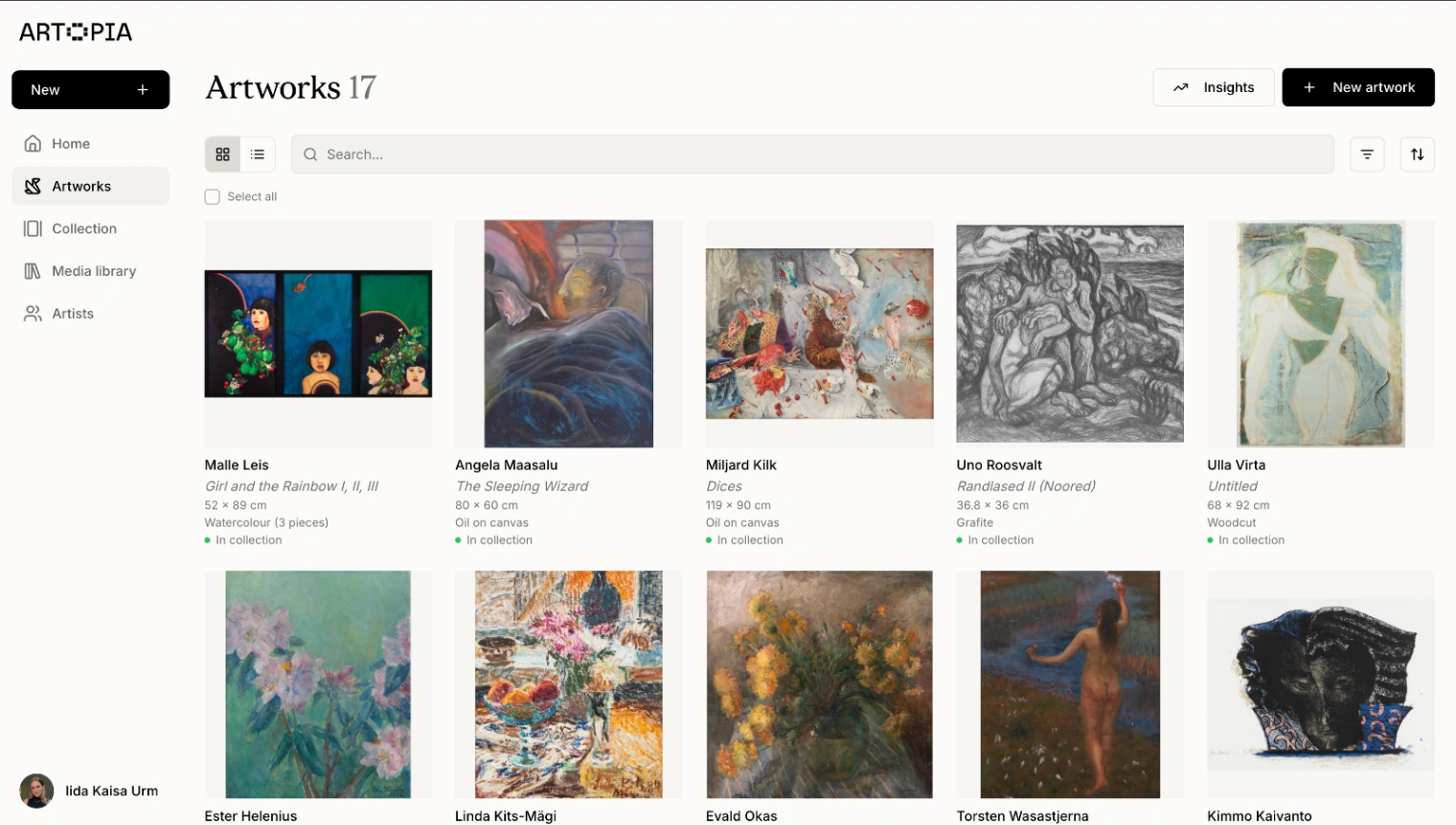
The core is simple: users document every artwork in one place such as details, invoices, certificates, images. That single source of truth makes it far easier to manage a collection professionally, whether that means approaching potential buyers, evaluating new acquisitions, lending works to exhibitions, or simply keeping a clear overview of everything you own. For collectors especially, there's a quieter reward in it, seeing an entire collection properly documented and accessible. As Iida Kaisa frames it, good documentation increases both the usability and the long-term value of individual works and the collection as a whole.
Under the hood: Artopia is a single-page React application powered by Supabase in the cloud. The deliberate aim has been to keep the stack lightweight, modern, and fast to iterate on.
The first real signs it was working came from two directions. Targeted Google Search ads began bringing in users who used the product exactly the way Iida Kaisa had imagined it being used. And when she started sending welcome emails to new signups, people replied with thoughtful, specific feature questions. That, she says, was the moment it felt like there was something genuinely worth building in this niche.
The Hard Part
Most founder stories locate the hardest chapter in the past. Iida Kaisa doesn't. "The hardest chapter is still ahead," she says.
So far, she's been building from her own pain point, which has made the work deeply rewarding even when the product was useful only to her. The real challenge now is different: getting Artopia in front of enough people who share that same problem, and turning that into a sustainable business.
That challenge connects to the assumption she got most wrong. "I genuinely love building products," she says with her ten years in tech design. "What doesn't come naturally is publicly sharing and promoting them." She had assumed that once the product was good enough, users would simply find it. They don't. Visibility, she learned, takes constant effort. Building the product is only a fraction of the work; the rest is consistently showing what you're doing and making yourself reachable to the people who need it.
What's Next
The three-year goal is concrete. Today Artopia manages around 170 art collections. Iida Kaisa wants that number to be 5,000 collections managed globally.
The shape of the company matters as much as the number. The aim is a lean, sustainable software business with low churn and a strong reputation for being the most lightweight and modern platform for collectors, advisors, artists, and galleries alike. Not the biggest. The best at one well-defined thing.
Off-Screen
"I've honestly fallen back mostly on a notebook and pen," she says. In an age of AI-driven information overload, the discipline of picking out what actually matters has become essential and if your hand can manage to write down a single keyword, there's probably something valuable in it. She favours a ring-binder notebook specifically because pages can be torn out; it sometimes stays open on her desk for days, the same keywords constantly in view. It works better, she says, than the chaos of a phone and computer. Out of the house, Apple Notes and its to-do lists do the job.
The books follow the same slow and considered recommendations, the kind that feel written for a film or series. Over the years she has returned more than once to John Berger's essay collection Ways of Seeing, based on the 1973 BBC series of the same name. More recent reads: Yesteryear and Tomorrow, and Tomorrow, and Tomorrow.
🎨 How you can help: Artopia's most valuable connection right now is collectors. Direct introductions, or partnerships with art advisors and galleries who work closely with collector clients. Iida Kaisa is also open to conversations with strategic investors who understand the art market and long-term software businesses. Reach out via LinkedIn or at art-opia.com.
Written by
Mihkel Hõbemägi · Co-founder, Built in Baltics