

The Leverage Point Isn't the Early Stage. It's Before the Stage. That's Why It's Called TooEarly.
Founder Stories by Built in Baltic. A conversation with Aneth Tinnus and Triinu Lukas, co-founders of TooEarly Ventures.

In this article
Seventeen startups have gone through validation with TooEarly in six months and the single most consistent surprise is this: the first idea is almost never the real idea. Several founders arrived with something specific and, by sprint four or five, were building something adjacent. Not because the original idea was wrong, but because understanding the problem deeply kept revealing a sharper entry point. For most investors, that would look like drift. For Aneth and Triinu, it's the entire thesis working exactly as designed.
How It Started
Both founders came out of the international early-stage accelerator world, pre-seed and seed, hands-on support, the works. That experience showed them what becomes possible when founders get real help. It also showed them the ceiling.

Most ideas that arrived had already been shaped by constraints that didn't need to exist: assumptions baked in too early, markets defined too narrowly, solutions built before the problem was understood. The same pattern kept repeating. "The real leverage point wasn't at the early stage," they realized. "It was before the stage."
That reframe made the question obvious: what if you backed people before they even had a company by intervening at the moment of idea formation, not idea acceleration? The venture studio model became the answer. And the name, fittingly, defines exactly the moment they step in: TooEarly.
Building From the Baltics
Estonia gives TooEarly something rare. The ability to test almost anything, fast. The startup density, the digital infrastructure and the trust networks mean a founder can reach a first paying customer, a critical domain expert, or a genuinely sceptical investor in days rather than months. Being powered by EBS (Estonian Business School) amplifies that: a community that takes building seriously and a warm pipeline of ideas from people already in a creation mindset.
The constraint a studio in Berlin or Paris wouldn't feel: every idea born here has to think globally from day one. There's simply no room for a local-first playbook in a country of 1.4 million people. Aneth and Triinu have turned that into a filter rather than a limitation as founders who clear validation here tend to be more internationally ambitious than peers in larger markets, because they never had the option to think small.
That's also the part they want to export. The real goal is to replicate the university-backed studio model with other universities across Estonia and Europe by pulling builders into academia and academic insight out into the market, depending on which direction a given idea needs to travel.
What They Back
TooEarly's filter is deceptively simple: real demand, real urgency, real founders. Each word does specific work.
Real demand looks like someone already solving a problem in a clumsy way. A customer who built a spreadsheet for something that should be software, hired a freelancer to patch a structural gap, or describes a frustration with the specificity of someone who's lived with it for months. A shrug and "it would be nice to have" is the opposite of a signal.
Real urgency is a deadline attached to the status quo. Competitive pressure, a regulatory shift, a personal inflection point that makes this the year, not eventually. They look for founders who can answer why now, not just why.
Real founders, this early, isn't about track record. They screen for intellectual honesty about what a person doesn't yet know and for stubborn attachment to the problem rather than a specific solution, since the pivot can come early. The last question is always: why is this person the one to solve it? Background, domain access, obsession as there has to be a clear, specific answer.
How the Program Runs
Week one looks almost nothing like month six. The first sprint is always customer discovery, out of the building, into real conversations because nearly every idea changes shape once it meets the people who actually have the problem. Nobody touches the product until that work is done.
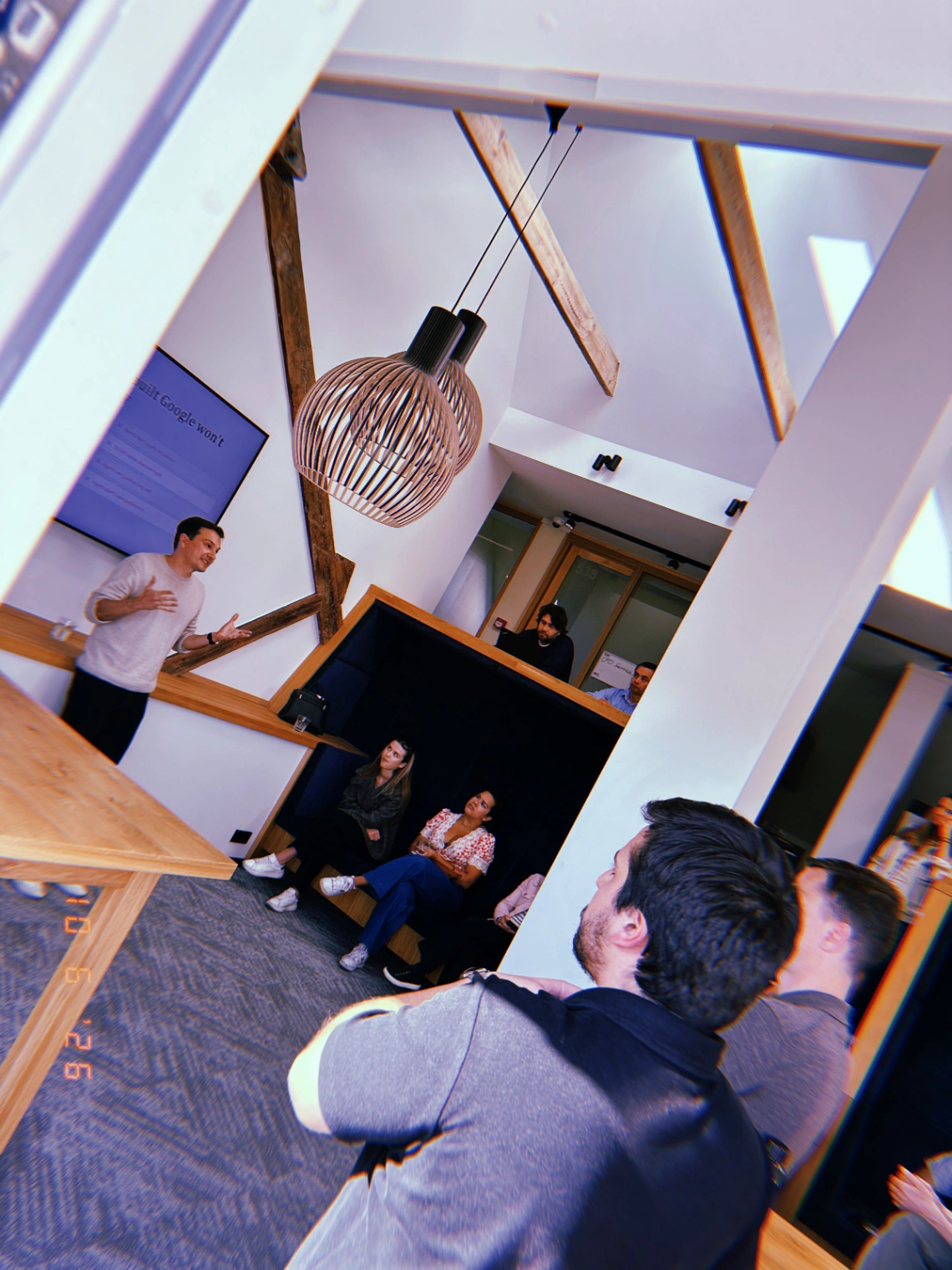
From there, the program runs in weekly sprints with the suitable order and track for each idea and startup. The agenda is built around one question: what does this founder need to unblock right now? Customer discovery one week, early sales the next, then team formation, MVP scoping, or business-model stress-testing in whatever order the company actually requires. The work happens at the TooEarly studio at EBS in central Tallinn, alongside the team and other founders in the same phase.
Roughly 10% go further into the next phase, the Builder's Program, typically with a functioning early product, evidence of real demand and a clean answer to what's needed to deliver for a first concrete client. That's the path TooEarly funds.
The Hard Part
The hardest design question wasn't structural or financial. It was definitional: what does support even mean when there's no product yet?
The temptation is to import the classic accelerator playbook of workshops, speakers, demo day. But that structure assumes a company already exists to run through it. Aneth and Triinu had to rebuild from scratch what it looks like to work with someone who has only an idea and a strong pull toward a problem. The weekly-sprint model came directly out of that struggle: not a program to complete, but a recurring question about what a specific founder needs to unblock next.
The other thing that broke old assumptions was where the strongest founders came from. Some of the most compelling ideas arrived from fields they'd never have predicted. Deep domain experts who'd been sitting on a problem for years without realizing there was a buildable company inside it. Not the obvious startup profiles. People who knew something so deeply that the gap they saw was invisible to everyone else.
And the clearest proof the model works is partly a story of what didn't happen: founders didn't spend six months building something nobody wanted. The uncomfortable early customer conversations, the sprint that surfaces a wrong assumption before any real capital is committed. That compression of the feedback loop is exactly what the studio model buys.
What's Next
In three years, TooEarly expects a portfolio of around fifteen companies at various stages, with at least half having travelled the full arc from idea to early traction to follow-on capital. The studio is sector-agnostic by design, though themes are already emerging from the problems Estonian and European founders sit closest to.
There's a physical anchor coming, too: EBS is building Eedu, a new education and business campus in central Tallinn and TooEarly will move there in 2027 as the central entrepreneurial studio in the hub. Beyond Estonia, they're in active conversations with other European universities about bringing pre-company support into academic environments.
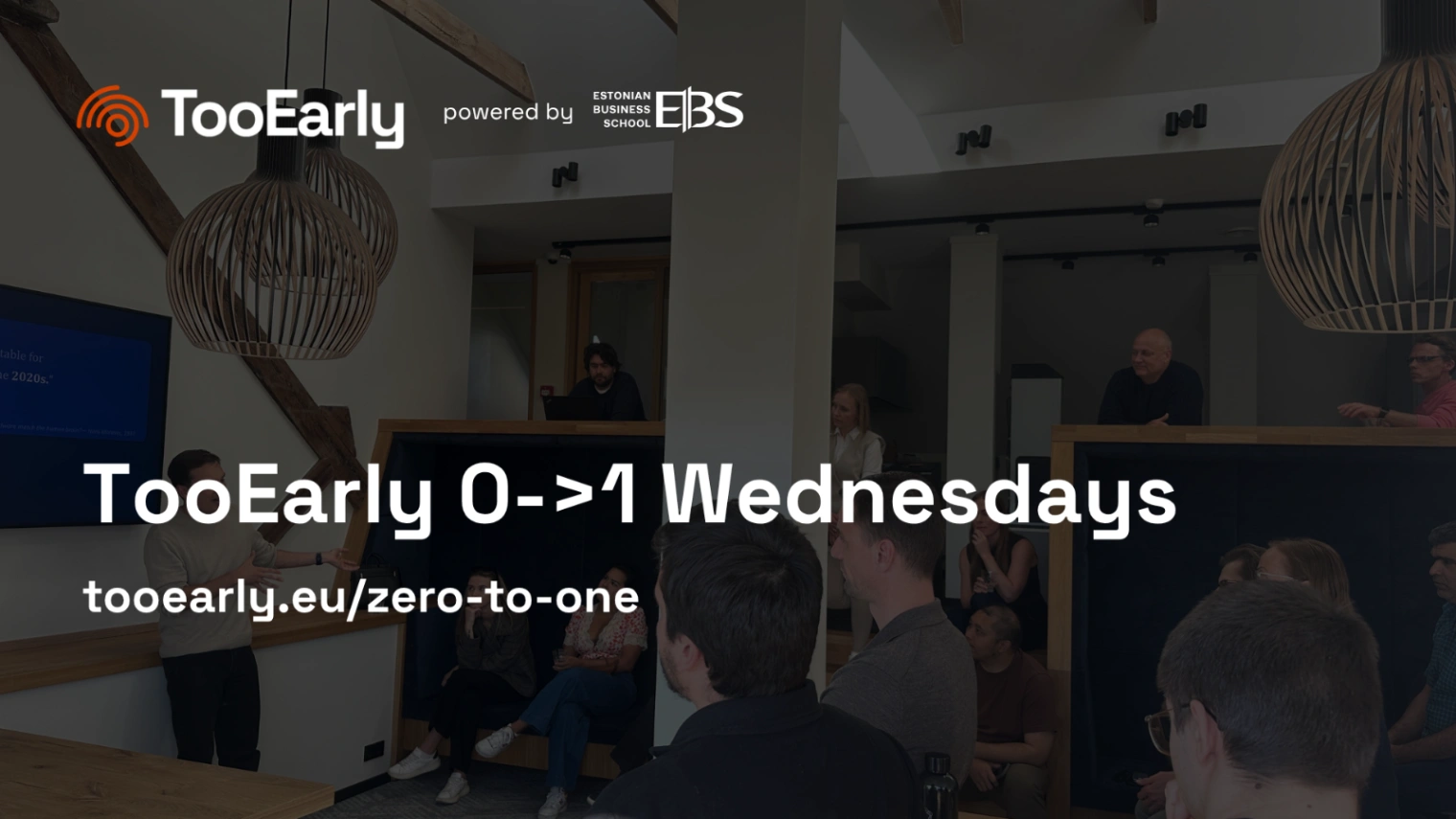
The metaphor they keep returning to is a galaxy. Right now it's forming. They have already seen the first stars and together with the whole ecosystem, or other part in the galaxy, they help the stars to shine. In three years, the stars will be few breakout companies that make the whole thesis legible to the next wave of founders wondering whether to apply, and the investors wondering whether to show up to 0→1 Wednesdays. It’s the TooEarly event series, where the newest TooEarly founders deliver their first pitch and where they have the open mic for the wider audience.
Founders on Founders
The two co-founders were asked for a recommendation each. They took the question in characteristically different directions.
Aneth made it about people. TooEarly's biggest goal is finding real talent, so her advice is to be deliberate about who you build with: find the best possible co-founder match because that's the most important power you have when building a company. Her second tip is to protect your mental health, which in fast-paced startup life is best done through physical health: the neurochemical boost from a workout lifts everything else. Her current book pick is Eric Ries's Incorruptible: Why Good Companies Go Bad and How Great Companies Stay Great which reframes corporate governance not as compliance but as a creative, strategic act.
Triinu pushed back on books entirely, at least at the start. "Books are fine, but they won't get you closer to your goal if you're ready to start building. Only going out there talking to potential clients can." Her one exception is for teams that have already scaled to ten-plus people: Patrick Lencioni's The Five Dysfunctions of a Team, because at that size, leadership skill becomes a necessity and people make or break the company.
🌌 Who they're looking for
People who've been sitting on a problem longer than they've been thinking about starting a company.
The EBS student who keeps seeing the same gap in their industry.
The operator who left a company knowing exactly what was broken.
The researcher with deep domain knowledge and a nagging sense there's a buildable solution in there.
Even someone still in their day job, itching to build something of their own.
No polished pitch decks required. TooEarly is looking for people who carry a real problem and have the drive to build around it. The shape of the company can still be wide open. Reach out via tooearly.eu, or come to the next 0→1 Wednesday.
Written by
Mihkel Hõbemägi · Co-founder, Built in Baltics